
My son and I both grew up with the magic of dyslexia.
I created this website to help parents and children understand dyslexia, with special emphasis on its strengths (the magic).
Introduction
The main strength of dyslexia is a brain that works 100 times faster than a person without the magic. This is due the ability of a spinning mind’s-eye which each dyslexic person has.
What is a Mind’s-Eye
Everyone has a mind’s-eye. The best way to explain this is with a thought experiment.
When you are away from home, try the following: Close your eyes and imagine that you are standing in your lounge with your back to your TV. Can you describe what you see to your left and what you see to your right. Now, still with your eyes closed, go to the kitchen, open the fridge and imagine what is the first thing you see. The trick is not to do this from memory, but to close your eyes and do it in your imagination. You will easily be able to do this and be able to give answers.
All the above is being done with your mind’s-eye. With your eyes closed you can place yourself in your lounge or kitchen or anywhere you want. When you place your mind’s-eye in a location you can move it around in the location. Within an instance you can move it to a completely different location, like your favourite place in nature.
Note: Be aware that when some people close their eyes, and use their imagination, they can see vivid images, others don’t (they see blackness).
What is a Spinning Mind’s-Eye
Now this is the magic. Once again the best way to explain this is with a thought experiment.
The scenario is a large family get-together at a house. A child is sitting on a bed in one of the bedrooms. Someone holds their hand in the doorway and the only thing the child on the bed sees is the hand. The child now thinks to themselves “I wonder who that is”.
A non-dyslexic child processes as follows: They think to themselves; it looks like a male hand. It is quite a big hand. It must be either Uncle Peter or Uncle John. The hand has a wedding ring on it. Oh! I think it’s Uncle John. Within a few seconds they have worked it out.
A dyslexic child processes as follows: Immediate they know, Oh! Its Uncle John.
So what happened here. (The below might sound strange but I have explained it to many dyslexic people and it does not sound strange to them.)
The dyslexic child sees the hand and in an instant their mind’s-eye zooms over to the hand and spins around it in all directions (like a super-fast drone) and immediately the image of Uncle John appears. The child is not aware that their mind’s-eye is doing this, they just immediate know it is uncle John. The child might feel a bit dizzy as it happens.
The concept of the spinning mind’s-eye originated from Ron Davis who did groundbreaking clinical research into dyslexia in the 1990s. Ron’s example is a child seeing a ball of fur on the other side of the room. In an instant their mind’s eye zooms over to the ball of fur, spins around it and immediately the image of a cat appears.
Linear-Sequential and Visual-Spatial
In the above thought experiment the non-dyslexia child sitting on the bed used linear-sequential thinking to answer the question. The dyslexic child used their mind’s-eye which can be described as visual-spatial thinking. At the end of the day the dyslexic child’s visual-spatial method is 100 times faster than the linear-sequential method, and is more accurate.
A Baby’s Brain Develops
We all know the first five years of a child’s brain development is very important. As a baby grows up they use and develop both their linear-sequential ability and their visual-spatial ability.
The dyslexic baby spends much more time using their visual-spatial ability, after all it is 100 times faster and more accurate. The linear-sequential ability is still used, but much less. The ratio of visual-spatial to linear-sequential varies from child to child.
On the other hand, the non-dyslexic baby uses and develops their linear-sequential ability. Even though it is slow and not so accurate.
Virtually all babies are dominate in one or the other, about 80% in linear-sequential ability and 20% in visual-spatial ability. In very rare cases a baby can excel in both visual-spatial and linear-sequential ability. This is a gifted child.
A Toddler Goes to School
At school children learn the alphabet and learn to sound out the letters. For a dyslexic child this is not a problem, except for the 'b', 'd' and 'p' as the spinning mind's-eye gets them confused, but generally the dyslexic child is okay at learning the alphabet. However, the teacher then writes a word on the board (eg ‘tap’) and asks the class to sound out the word.
For a dyslexic child this is a big problem. Their mind’s-eye zooms out and spins around the letters in all directions trying to visually see the word (the word is pulled apart and reassembled in every combination). The following immediately, all together, appears to them; pat apt apʇ tap ʇɐd pɐt tab dʇɐ bat ʇɐb tɐp pta ʇɐp etc etc. There are over 350 combinations of these three letters. Each letter and combination of letters can be seen upside-down and/or the wrong-way-around. The dyslexic child also feels a bit disorientated and dizzy when trying to make out the word.
When pushed for an answer the dyslexic child might even say the word says ‘bat’ (one of the combinations). Now, the teacher, parents and friends all think the child is trying to be funny, is mischievous, is just guessing, is not trying or is stupid. But this is not the case at all.
For a non-dyslexic (slow liner-sequential thinker) sounding out the word is relatively easy. Reading, writing and spelling is natural for non-dyslexic children.
Note: With over 350 combinations for the word 'tap', it seems unreadable. But the dyslexic child does learn to read. For one thing an upside-down and wrong-way-round “ʇ” is still a “t”. So the word 'tap' actually only has 18 combinations and the word 'cat' has 6 combinations (cat, cta, act, atc, tca & tac). The difference between 'tap' and 'cat' is that b, d & p are the same letter to a dyslexic (especially in the beginning). To see an example of b, d & p click here (video starts at 60 seconds in). Luckily the other 23 letters in the alphabet do not have the same problem, and luckily no capital letters have the problem.
Higher Education and the World
Most dyslexic children struggle though school but manage to cope. They have too, because everything revolves around reading and writing.
However, after school, this is where the young adult dyslexic starts to shine. When a young adult starts learning to become an architect, a surgeon, a scientist, engineer etc. Suddenly, the visual-spatial ability becomes a huge advantage. The student sees solutions immediately in their mind’s-eye and can think naturally in the visual world. Actually, you will find that the best architects, surgeons, design engineers, inventors etc are dyslexic (i.e. bad spellers and a bit slow at reading). In fact, the world would not be nearly as advanced as it is without dyslexic people.
------------------------------------------------------------------------
Note: A lot of the above is based on Ron Davis’ book “The Gift of Dyslexia”. I have explain it in my own words, added extra ideas and created some thought experiments to help me explain it.
Below is an image I found in a few Internet articles on the subject of dyslexia. The articles don't talk about a spinning mind's eye, but the image is a good example of how a dyslexic child sees words.
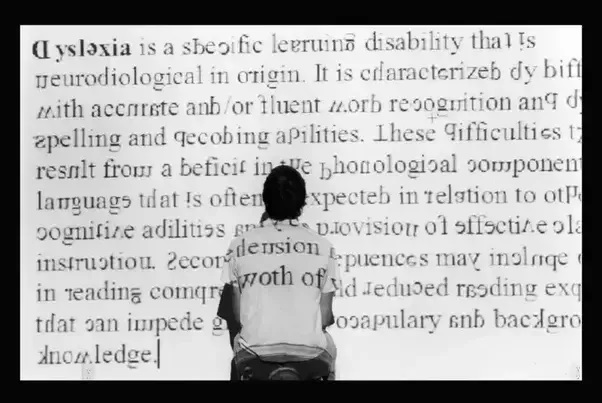
I find it interesting that if a non-dyslexic child had to stand up in front of a class and read the above image out aloud, they would sound exactly like a dyslexic child. (Now you know what it feels like.)